Disclosure: This post (probably) contains affiliate links. If you click on one, I may make a small commission. Of course, this will come at no extra cost to you and helps keep this site running.
Men tayyorman! Siz tayyormisiz?
It has been 2 weeks now since I started my 90 Day Uzbek Challenge using Glossika. I am loving the journey of learning Uzbek. I even got to say a word or two in Uzbek this week at a local Uzbek restaurant in my neighborhood. Soon I’ll be communicating even more.
Glossika Progress
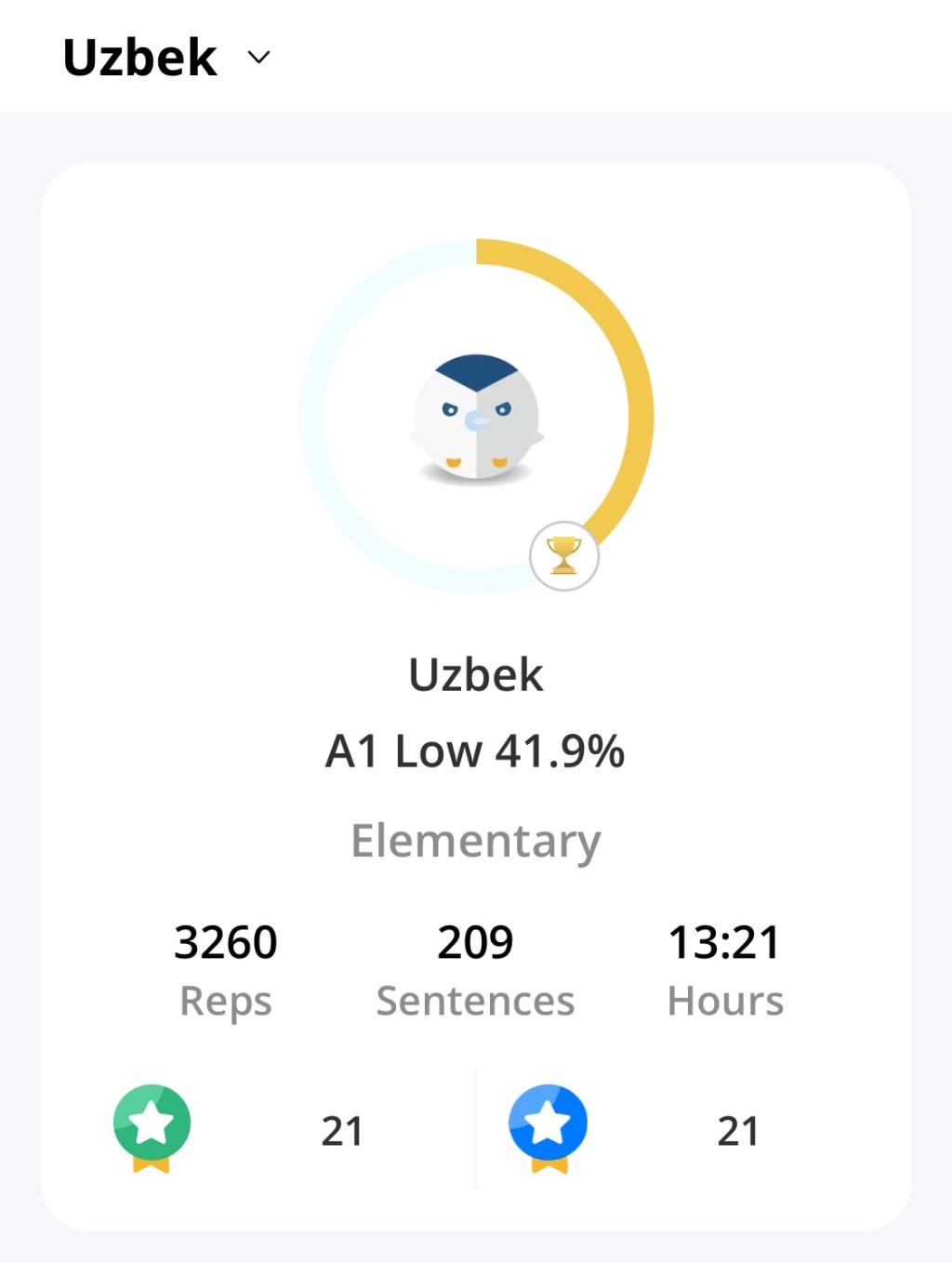
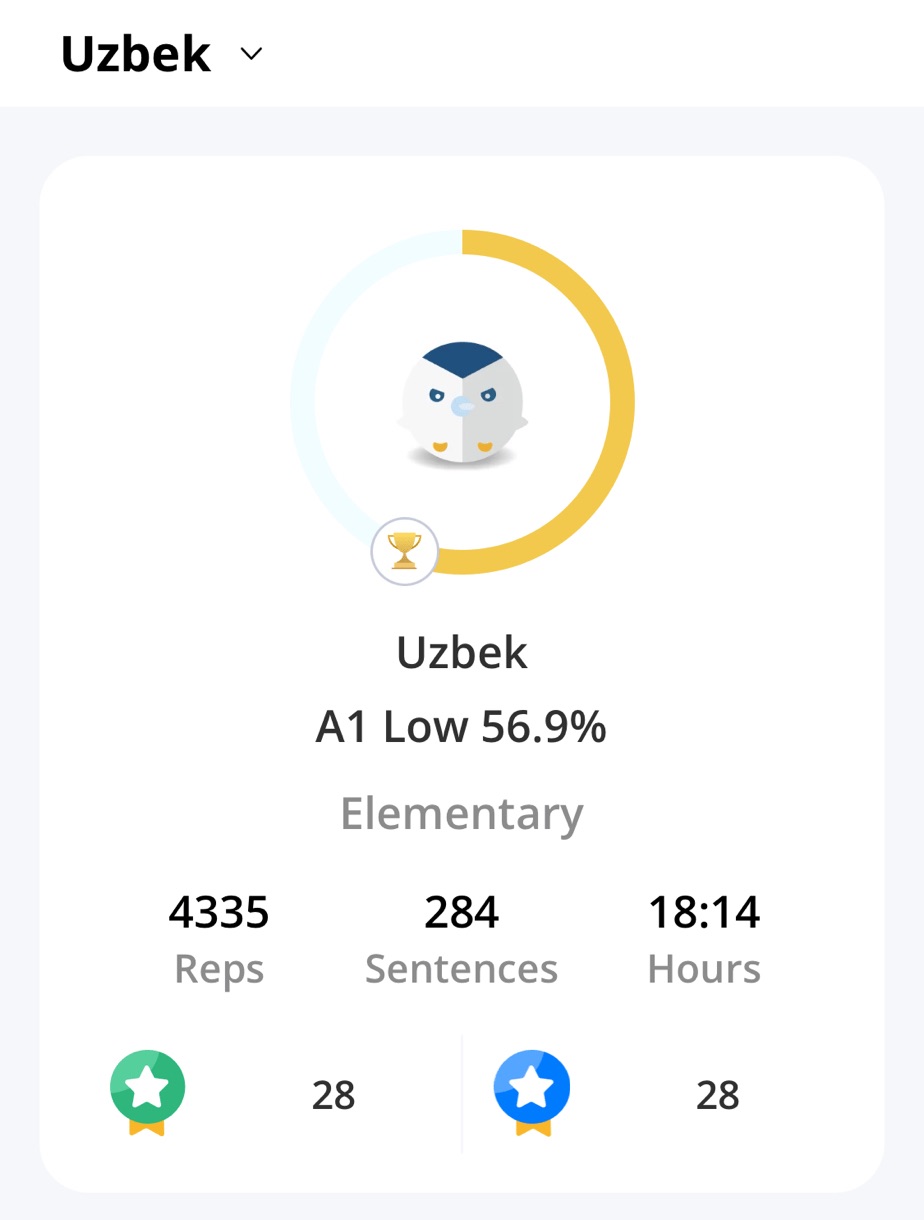
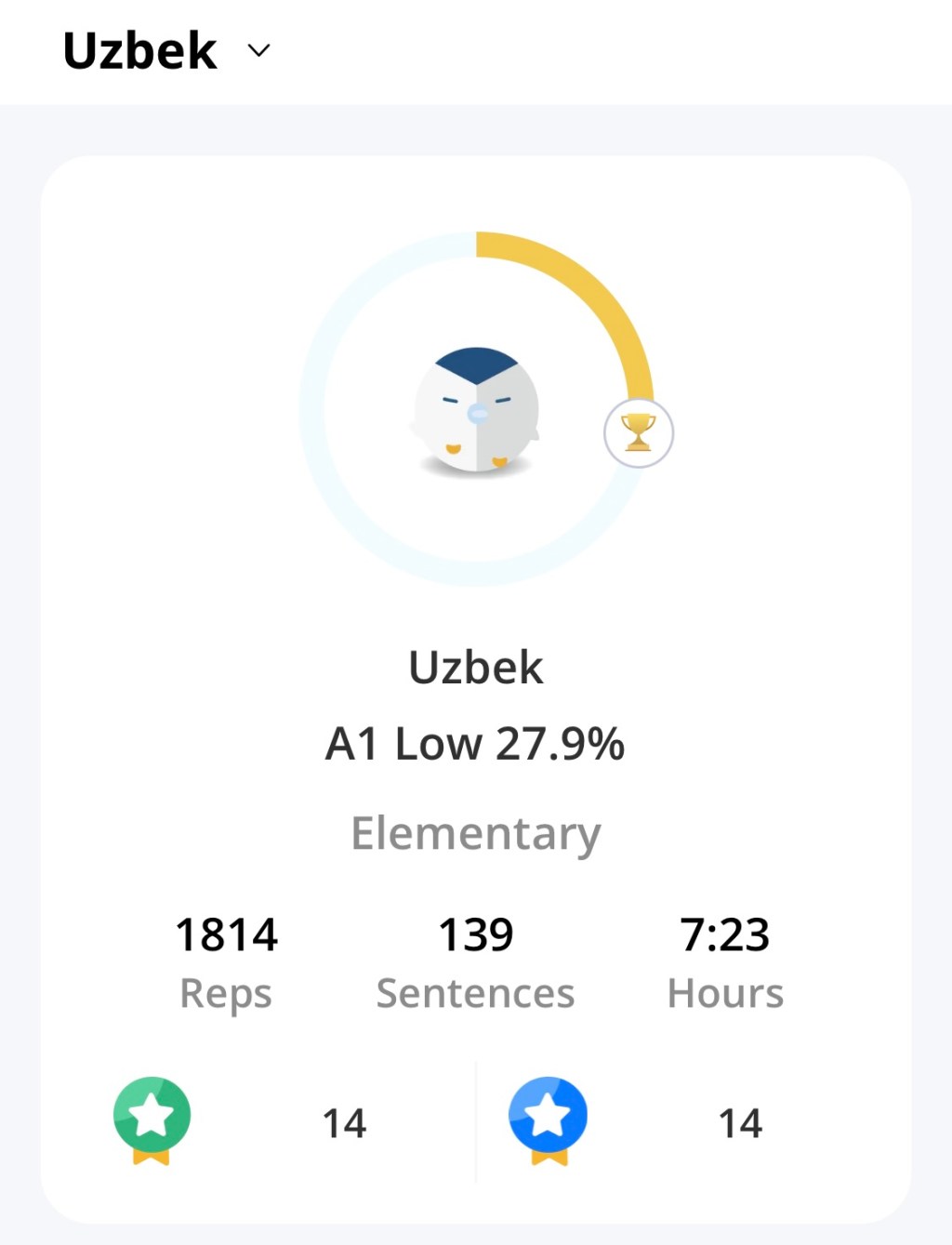
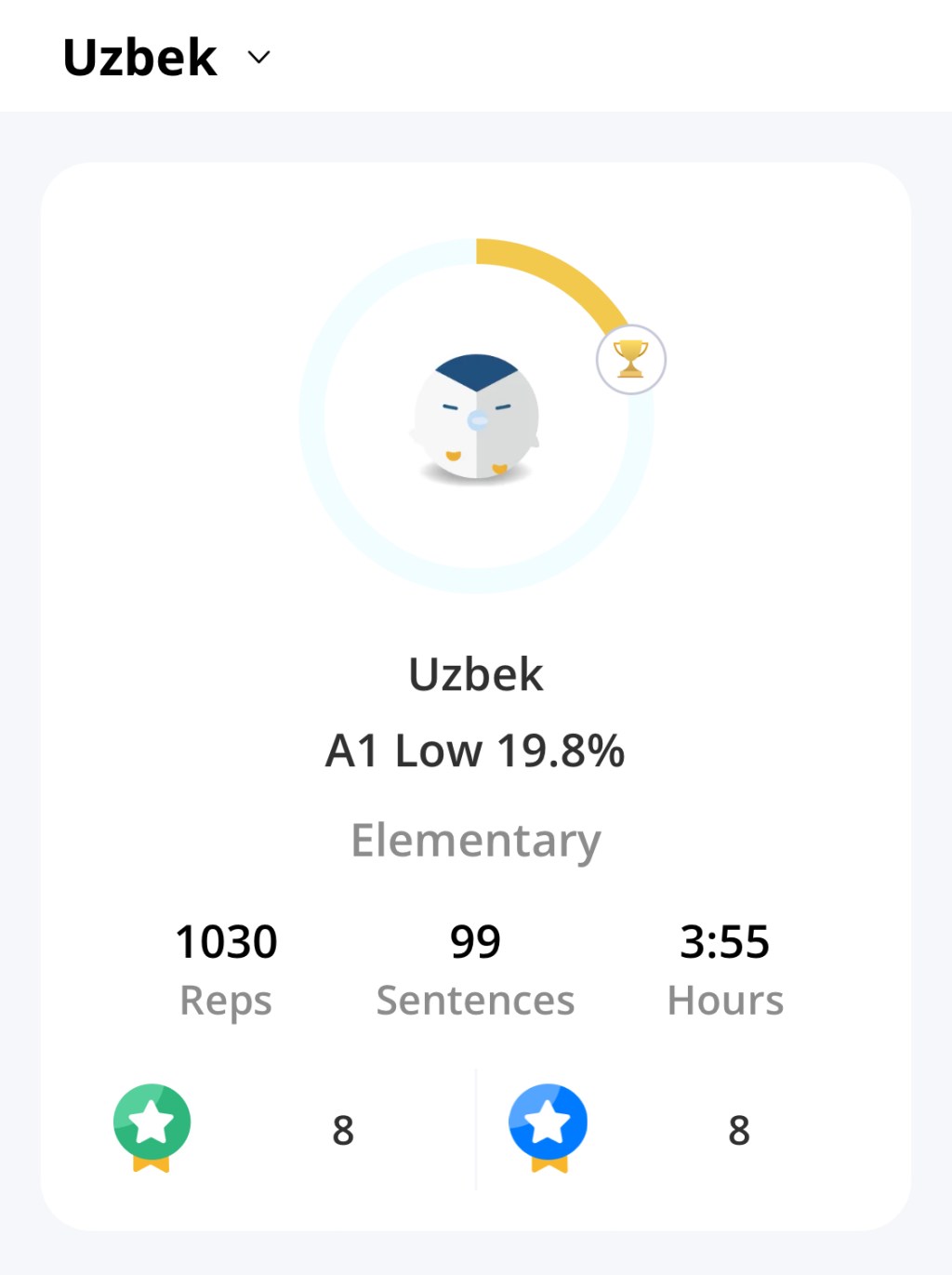
This week I completed a total of 1,446 reps, which puts me at a total of 3,260 reps completed overall. Each day I have been consistently completing all my review reps before moving on to new sentence reps. It seems like a good habit. As I mentioned in my check-in last week, I have set my reps just a bit higher for each day. Currently my daily goal is 100 practice reps and 50 new sentence reps. I realized this week that I might have been approaching my practice reps in a less-than-ideal way. I forgot that there were various way to approach my daily review.
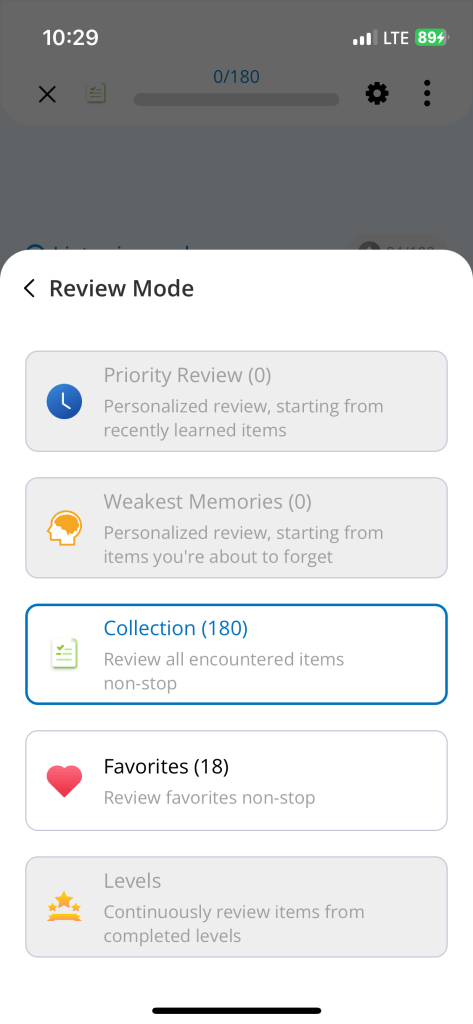
In practice reps, if you tap the little icon in the top bar sitting between the X and the progress bar, you’ll find different options for viewing practice reps. If I review my “Collection,” I’ll be reviewing every sentence I’ve seen so far. So I’ll have 180 reps to complete the whole set. Today, when I started my review, I only had 80 reps in my “Priority Review” set. At first it seemed like an awful lot of review to do. I was consistently seeing between 140-180 reps in my review list. Once I realized I could change this view and focus in on Priority Review, I felt a lot better. Many days I ended up actually doing the full Collection review and more, but it is nice to know that the review may be less heavy than I was imagining. I’ll be checking back in on this next week for sure. As a side note, I have a Favorites list where I tap the heart icon on some sentences where I think they would be directly useful. This makes it easier to come back and review them quickly.
Other Resources I’m Using
This week my curiosity started to grow and I couldn’t help but start looking for other resources to supplement what I’m doing. I’ll share a bit in the following paragraphs about the various resources I discovered this week and how I’m using them. Some are more important than others, but I’m also happy to share what I’m finding because of how under-resourced Uzbek is as a language.
iTalki Tutor
I took my first Uzbek lesson on iTalki this week with Ibrahim. It was a great experience. I actually think using Glossika helped me with my jump into it. He provided me with a PDF of a good Uzbek textbook that we are working through. I was really excited about getting access to that too. Either way, working with him was a lot of fun and really helpful. I immediately purchased a lesson packet of 5 more 1-hour lessons with him. I plan to take a lesson each week if possible. I can schedule them as I want, which is a big benefit.
I have used a number of services and tools to get where I am with Turkish so far. One of things I used most was iTalki for 1:1 online tutoring. I have taken lessons in Turkish, French, Indonesian, and now Uzbek. I’m currently writing a longer review of iTalki to go into detail on how I have used it and how valuable it has been for me. I’m excited to share that with you.
Uzbek Grammar Book
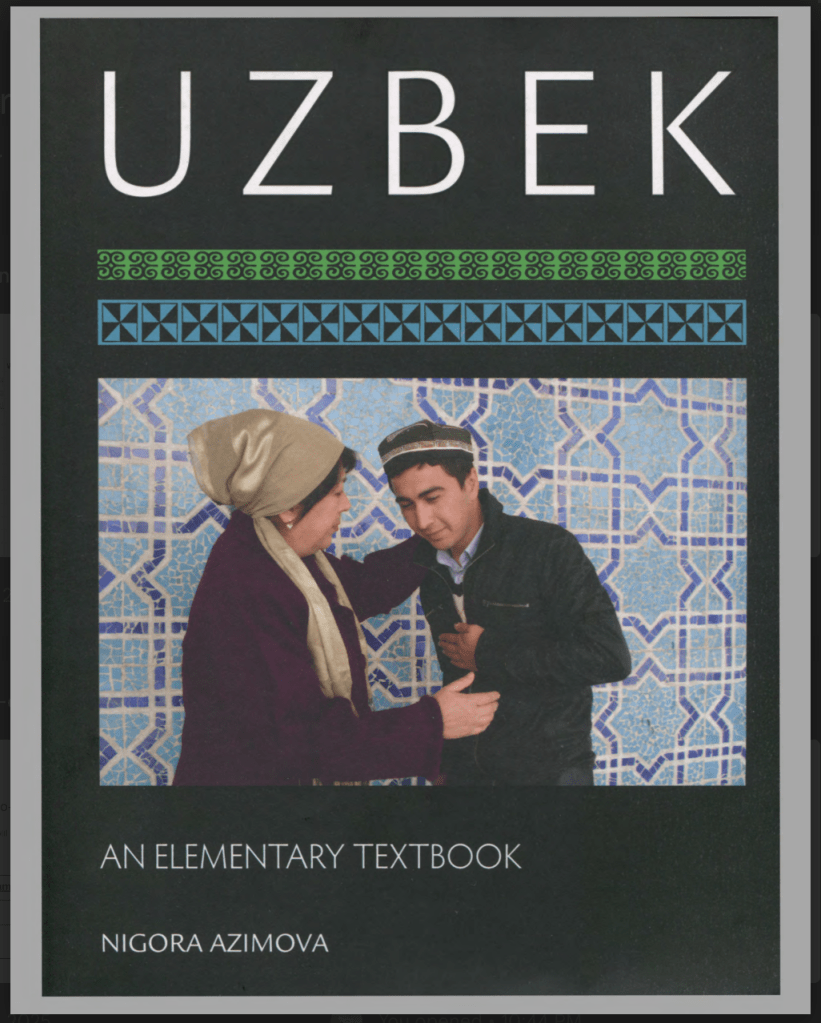
The funny thing about this textbook is that while it is published by Georgetown Press in the US, like most other Uzbek textbooks, there are mistakes in it and inconsistencies. I’ve never come across something like this before. It makes me chuckle and it also reminds me of the human-ness of language. Even with a few errors along the way, it is still really nice to have access to a grammar textbook for reference. I’ll be working through this with Ibrahim in our lessons and I’ll be looking through it on my own from time to time too.
Anki Deck
This week I did a little digging to see if I could find an Anki deck for Uzbek to supplement what I’m doing. If you don’t know, Anki is a digital flashcard app. You can use it free online or on the computer. You have to pay a one time fee to download it for you iPhone or Android phone. It is a reasonable cost, though.
To be candid, I don’t really like using Anki all that much. In theory, it should be a great resource and super effective. Lots of people love using Anki and use it extensively. I’m a bit jealous of them sometimes. I can use it for a bit, but then I tend to tire of it pretty quickly.
In my search, I found a post on Reddit called 80 Free Anki Decks Across 69 Languages where I found an Uzbek deck listed in the mix. I noticed at the bottom the writer’s final note said, “TL;DR: I am making free beginner Anki decks for every known living language, these are all the dropbox links of what I have so far, have fun! If you can’t decide on a language, learn Uzbek.” Well, I guess we’re on the same page then!
According to the post, these decks are not about getting to serious depth. They are all meant to get to a survival level in each of the languages. I love that. Personally, if I want to use Anki to get to any real depth, it will only be by doing some sentence mining work (you can take a look at Refold for excellent information on how to do this) and building my own set of cards related to things I’m directly interested in.
I am currently using it a bit, but with no real commitment to staying consistent and using it well. I know me.
ChatGPT
I guess it wouldn’t be possible to write this without at least mentioning AI or ChatGPT or the like. I am cautious about trusting every detail of what I find on ChatGPT, but even with possible errors, it still seems like it offers some value. Since I already have a strong foundation in Turkish as I’m starting out in Uzbek, there are a lot of really familiar structures and vocabulary. When it comes to getting a sense of the shape of the language more quickly, I like using ChatGPT. I can ask things like:
- “Explain the basic verbal structure of Uzbek.”
- “Give me 10 examples of verbs in future tense in Uzbek and then use them in 10 different sentences.”
- “How do noun cases work in Uzbek?”
- What would you ask it about your target language?
I can check what ChatGPT gives me with the textbook I mentioned above. Even more usefully, I can make a note of anything that seems useful and bring it up with my tutor on iTalki in my next lesson.
Things I’m Noticing
- I started doing more full reps in Glossika with new sentences to practice typing in the Cyrillic script correctly. I could do it a little quicker this week and I did more reps with typing this week too. When you make a spelling mistake it simply adds one more rep to your quota. That can be frustrating if you knew how to spell it correctly but mistyped. And it can be much more tiring. If I was going to be writing in Uzbek and if that writing had to be in Cyrillic script, I would spend more time working through this.
- Taking my first iTalki lesson helped me make the decision not to spend my time working on typing in Cyrillic script. It turns out that while the older generation can generally only understand Cyrillic script, the younger generation only uses the Latin scrip and that’s the direction the country is heading. In my case, I wish the Glossika Uzbek course was in Latin script since that is how everything is done now. I am at least benefiting from getting some familiarity with the Cyrillic script too. Sometimes you have to take what you can get. If I ever end up getting to visit Uzbekistan, I’m sure there will be times where some familiarity with the Cyrillic script will be helpful. And on my long-term list, I hope to learn Russian one day. Getting more familiar with that script will only help when I jump into learning Russian. So for now, I’m fine with it.
- Using Glossika as my way of hearing, seeing, and speaking Uzbek throughout the week is a good primary thing. Adding in a lesson on iTalki each week is fanning the flame and it is so gratifying to use what I’m learning while adding to it. I think I’d be cheating myself if I postponed lessons like that.
The Week Ahead
In the coming week there are a few things I’d like to take a swing at:
- I’ll keep trying to slowly increase the overall number of reps I’m doing each day on Glossika. Keeping the momentum going is really good.
- I have scheduled another lesson on iTalki with Ibrahim.
- I’d like to start making my own list of sentences I want to be able to say.
- I’d like to go back to the local Uzbek restaurant in my neighborhood and use a few of the phrases and sentences I’m learning with the staff. They all speak Turkish too, so I can always fall back on that when I need to.
That’s it for now. I hope you’re enjoying following my journey in learning Uzbek. It’s a lot of fun for me and I hope it will encourage others to learn another language too. I’m sharing lots of specifics about Uzbek here. Most of what I share can be applied to just about any other language. Learning a language and then using it to connect and communicate with other people is such a gratifying experience. I hope you’ll join me in the fun!


 Along the Silk Road
One response to “90 Day Uzbek Challenge – Week 3”
[…] Last week I mentioned that I wanted to take a swing at a couple of other things. I didn’t make it to the Uzbek restaurant this time, and so I didn’t make my list of key phrases to be ready to use. I did however take another online lesson on iTalki. I’m really enjoying that process and I have another one scheduled for this weekend. I picked up a package of 5 lessons right after completing my first lesson a couple of weeks back. I ended up getting to use a couple of the phrases with my tutor anyway. These goals will be background ideas I hold on to. […]
LikeLike